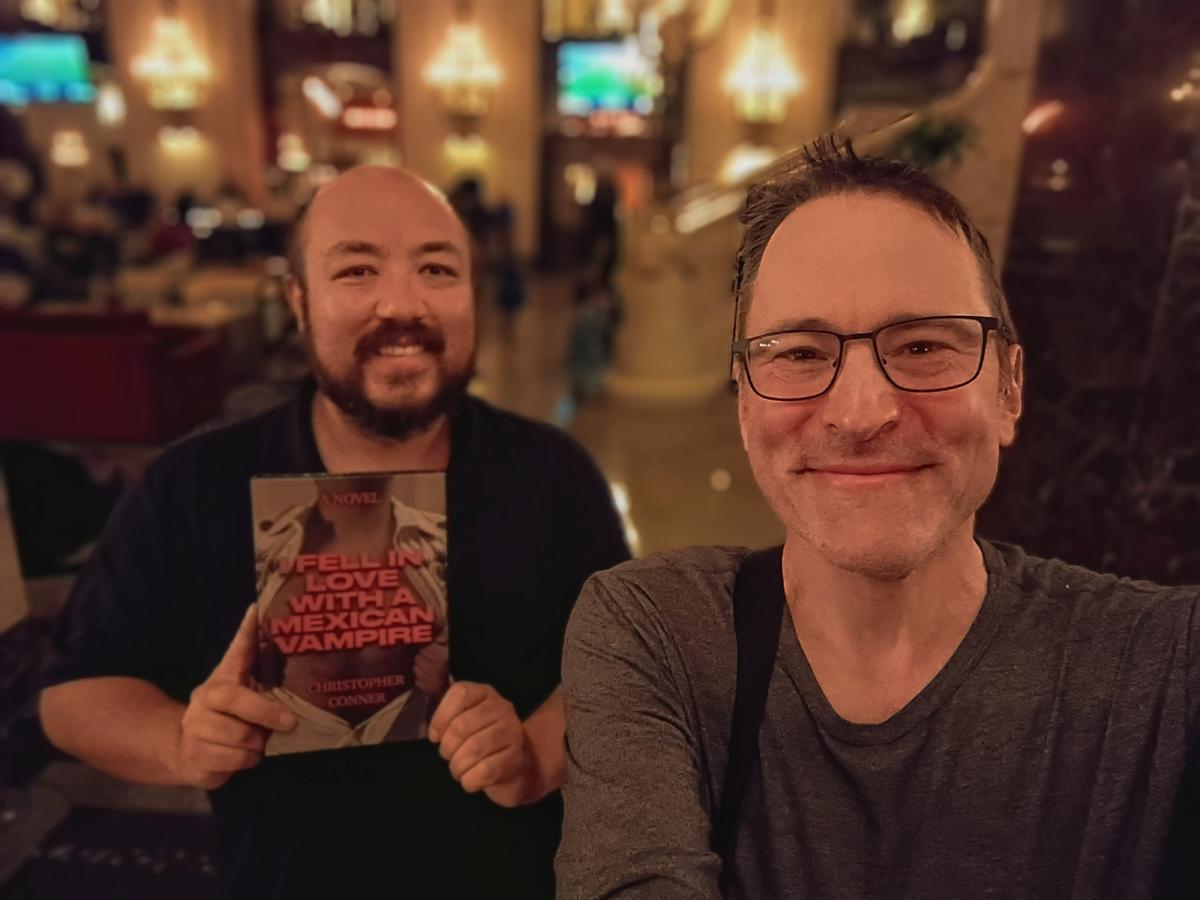

I am grateful to acknowledge and give a Filipino-American writer, filmmaker and performance artist their flowers. Christopher Conner consistently illustrates the importance of visibility in literature, and that itself is a legacy. Conner is his own storyteller legend, reminding his readers that "queerness is its own magic."
Conner graduated from New York University’s Tisch School of the Arts. He is the creator of "Prep School Blues," the cult-classic queer web series from 2008 to 2009 and young adult novel series from 2012 to 2020. His most recent novel is "I Fell in Love with a Mexican Vampire," published in 2025, and he plans to publish the sequel, "I Seduced a Gringo Couple and Drank Their Blood," later this year.
Finding refuge in the dark
Conner grew up in a very conservative family where sex and sexuality were not discussed.
"As I came into an awareness of my own sexuality and couldn’t talk about it, I found myself drawn to Gothic fiction as an escape," Conner says.
As a middle-school-aged boy, he became fascinated by the old 1960s television series "Dark Shadows," which he recorded on VHS tapes from reruns on the Syfy Channel. Actor Jonathan Frid’s performance as the reluctant vampire Barnabas Collins reflected Conner's own sense of carrying an unspoken secret.
Only many years later, after Frid’s death, did Conner learn that the actor was a gay man who remained closeted his entire life.
"Despite never publicly coming out, his screen persona impacted me across the generations," Conner reflects.
Later, in high school, Conner read the more explicitly homoerotic vampire novels of Anne Rice, which provided some of his earliest exposure to same-sex love and desire in fiction. During those years, writing short stories and drawing comic books, mostly pastiches of other Gothic franchises he enjoyed, provided his primary outlet for emotion.
"Later, when I eventually began work on 'I Fell in Love with a Mexican Vampire,' I wanted to evoke the same feelings of freedom and excitement I experienced through those youthful creative projects," he says.
Conner was lucky enough to attend Governor French Academy in Belleville, Illinois, a small private school where he was given the freedom to pursue his interests. This included student theatre, first as an actor and later as a director. Working on the plays of Tennessee Williams allowed him to hear the voice of a gay writer from the past, even one constrained by the social mores of his time. Theatre remains one of Conner's greatest passions.
The reality of coming out
When Conner left home at age 18 to attend NYU, he hoped to find a supportive queer community in the city. What he found in New York could not have been farther from what he had imagined from reading memoirs and novels.
"The young gay men at Tisch School of the Arts were among the most snobbish, superficial, and cliquish people I had ever met," Conner says. "At Tisch, if you didn’t have the physique of a bodybuilder or a ballet dancer, you were either body-shamed or completely ignored."
Conner did make some friends in college, some of whom collaborated with him on "Prep School Blues," but he did not feel comfortable dating. He remembers hearing that things are so much easier for gay guys at NYU, but that was not his experience at all. In many ways, he felt even more isolated after graduation and eventually returned to Southern Illinois.
Around this time, he became friends with queer historian Ian Darnell, who was then earning his doctorate at the University of Illinois Chicago and would later co-curate the groundbreaking exhibit Gateway to Pride at the Missouri History Museum. Every month or two, Conner would take the train to Chicago to visit Darnell.
The historian taught him a great deal about gay culture that Conner had never known and introduced him to people involved in activism and the fight for LGBTQ rights. It was around this same period that marriage equality became law in the United States.
"Although I was happy for other people, I believed a loving partnership was not something that would ever happen for me," Conner admits.
Borders, bodies, and broader horizons
Conner met his current partner, Juan Carlos Gonzalez Cruz, while traveling to Oaxaca, Mexico, for a Day of the Dead tour. This pivotal event in his life inspired the setting of "I Fell in Love with a Mexican Vampire," but meeting Carlos was more than just literary inspiration.
"Against all odds, we managed to connect across language, culture, and borders," Conner says.
Over the next few years, Conner traveled back and forth to Mexico to visit him, and eventually, after the global pandemic, they began traveling the world together. Carlos accompanied Conner to gay bear events in Puerto Vallarta, Mexico; Sitges, Spain; Gran Canaria, Spain; and, most recently, Bangkok. Through their travels, they met many wonderful people.
Conner was thrilled to discover a more inclusive community made up of people from all over the world who celebrate diverse body types.
"I now count myself fortunate to have a widespread network of international friends," he says. His experiences and observations of gay tourism also helped shape the plot of his upcoming novel, "I Seduced a Gringo Couple and Drank Their Blood."
Looking toward the future
It is difficult for Conner to offer advice to future generations because the world has changed so much during his lifetime and will likely change just as much during theirs.
"We have seen tremendous progress for LGBTQ people—perhaps the greatest advances in human history—but there is still a long way to go, and the rights we have achieved can be taken away," Conner warns.
He hopes people in the future will not judge current generations too harshly for the mistakes that have been made, or may be made again. "The queer elders who came before us weren’t perfect either," Conner notes. "They did the best they could with the world they inherited, and many left lasting impressions that we can still learn from today."
Conner does not know if his novels will survive the passing of time. "My hope is that my writing will impact future readers the way works from the past have impacted me," he says.