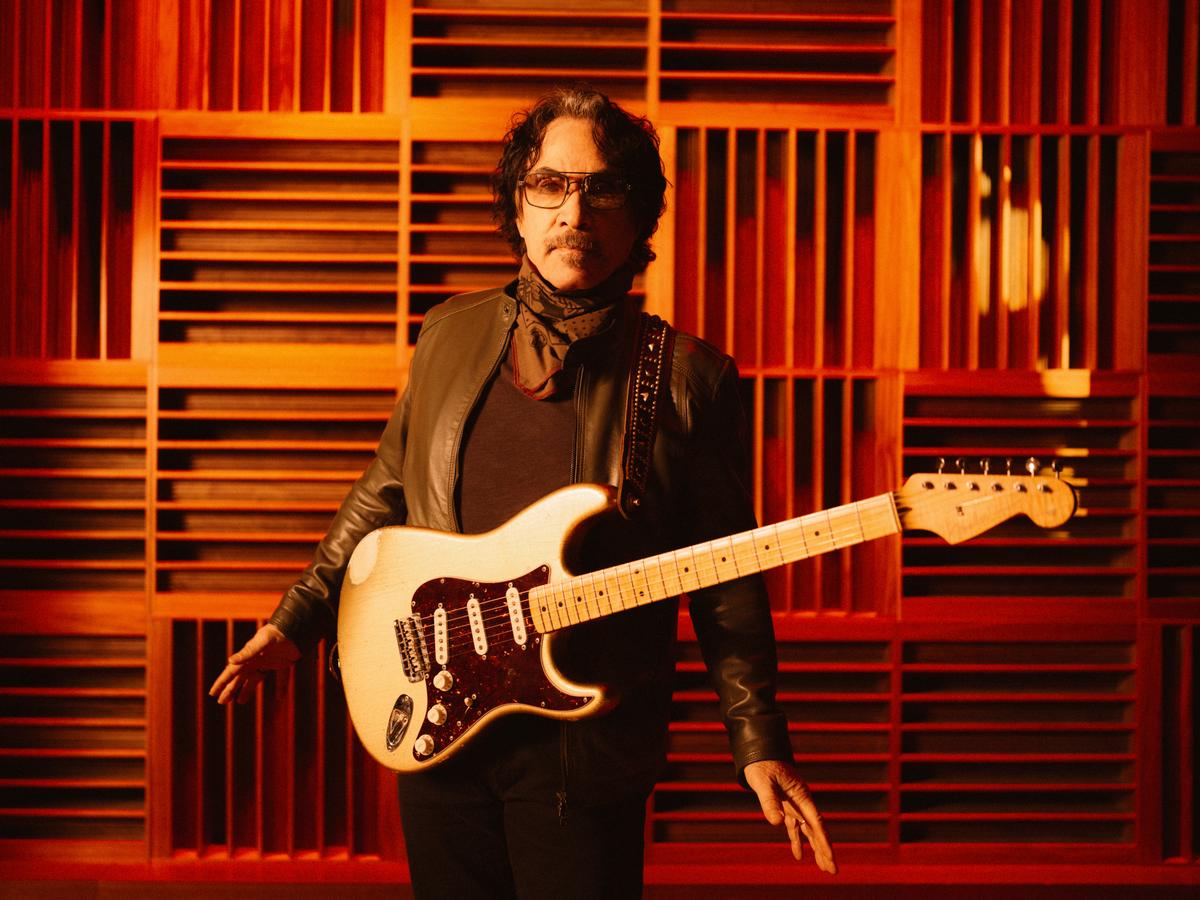
Musician John William Oates is a global icon with a huge career that has lasted for decades. He rose to fame as one-half of Hall & Oates and the duo recorded a huge number of memorable hits, including “Sara Smile”, “I Can’t Go for That (No Can Do)” and “Maneater.”
Oates went solo in 2002 for Phunk Shui and created The Good Road Band for his record Arkansas in 2018.
John took his latest 13-track solo album, Oates, out on the road this year and chatted backstage at The Gennessee Theatre before his recent concert in Illinois.
JN: (Jerry Nunn) I grew up in Nashville, where you live now. How has the Music City treated you?
JO: (John Oates) I feel like I have ridden the wave on the rise of the new Nashville. I started going there in the ‘90s to write new songs and I was still living in Colorado at the time. I made friends and got my feet wet to learn about the music scene.
The first album I made there was in 2006 and I was making another record in 2010 when the flood hit there. The city hit a low point where things just stopped and people lost their homes.
Nashville rebuilt really quickly, so in 2010, my wife and I decided to move there. I saw it grow year after year. I feel it is the epicenter of American music now.
JN: Do you have a favorite thing about Nashville?
JO: Yes, my favorite thing is the music community. It not only has great songwriters and musicians, but there is an infrastructure that supports that. Unless you are a professional, you might not think about things like that.
When someone wants to make music, it’s all there and it just works.
JN: Is that where you made the album, Oates?
JO: Yes. I did some overdubs with group parts in New York because of a tight schedule. It was fun to go there because I recorded at The Hit Factory. Daryl and I recorded at the original Hit Factory in the ‘70s. The guy who originally owned it was a good friend of mine and he passed away. I remember his son playing in the studio at 10 years old and now he runs it as the new Hit Factory down in Soho. It was a full circle moment to go to New York and record with the new generation.
JN: Is your son a musician?
JO: No.
JN: Where did you find The Good Road Band?
JO: Our drummer, John Michel, I met in Colorado in the ‘90s. We have been playing together for almost 30 years.
Kevin McKendree, on keyboards, whom I have played with since 2008.
Our bass player, Marc Rogers, was on the Reunion and Oates albums. He brought along a young guitar player, Seth Cook.
It’s a mix of older and younger performers.
JN: What was your concept for the album, Oates?
JO: I had made a record the year before it called Reunion. It was very acoustic and a singer/songwriter type of concept. I co-wrote the title track Reunion with AJ Croce.
I had been working in Americana music for years and I wanted to make the ultimate expression of that. Reunion is that and my best acoustic album.
There are so many legendary players on the record, like Sierra Hull and Jerry Douglas.
After I was done with that project, I wanted to pull out my Stratocaster. It was as simple as that.
JN: Who did you work with on Oates?
JO: The catalyst for making it was when I ran into Devon Gilfillian. He’s a new artist. You should check him out. He is originally from Philadelphia, but he now lives in Nashville, where we met.
He’s a great singer and very charismatic. We started talking and wanted to write a song together. He came over to the house and we wrote a cool song together called “Mending.” We sang it as a duet and then I started writing in that style.
JN: How was working with the band Lawrence on “Enough Is Enough?”
JO: I wrote a song that sounded like them and then I got a hold of them to collaborate more on it.
The record took on a life of its own. I had a few songs that I released only digitally as standalone singles, like “Disconnected” and “Pushin’ a Rock.” They didn’t get the attention they deserved and seemed to fit in the style where I was going with the new material. I put them all together on Oates and that’s how it was formed into a record.
JN: When you are on tour, are people requesting songs that you refuse to play?
JO: I don’t do many Daryl Hall & John Oates songs because it is not what the show is about. I do a few that I feel comfortable with and the ones I do, I make my own.
At this point, the Hall & Oates legacy has been documented over the years. There are live concerts on video with all of the hits.
JN: I grew up watching Hall & Oates videos and it seemed like you were the jokester. Are you like that in real life?
JO: I didn’t have a lot to do in those videos. Daryl was singing lead and he was the focal point, pretty much. I just had to jump around.
To be honest with you, it was kind of boring for me. There was no challenge in it. As time went on, it was the end of me working with him. I was tired of traveling around with the hits like a huge jukebox.
Here’s the thing: Daryl and I had the world’s best commercial problem. We had too many hits. For our concert, we would just play a string of hits. That’s what the audience wanted, of course and that’s fine. As an artist who wanted to be creative, it was like sleepwalking. I grew tired of it.
As I have gotten older, I realized there is a time stamp on my creativity, along with my ability to sing and tour. I notice my contemporaries falling by the wayside. I felt I had no time to waste.
I could divide my creative energies between going out on tour with Daryl and new music.
I am an established artist now with nine solo albums.
JN: That’s a big catalogue of work.
JO: I wanted to give my solo career a hundred percent of my time and attention as opposed to fifty percent. That’s what I have been doing through the 2000s and now it is time to just do this.
JN: Do you have a memorable wild fan story that sticks out from over the years?
JO: There are lots of them after touring for 50 years. When Daryl and I took our first trip to Australia, we were robbed at gunpoint by a crazy man with a sawed-off shotgun. He was known as the rusty gun bandit because he had a rusty handgun.
We were at a restaurant in Melbourne and we had just arrived in Australia for our first show. They kept the restaurant open for us even though it was after closing time. We were at a little table and across the way was the chef and his wife. We were having a late-night bite with a few other people and along comes a guy with a gun and a ski mask.
We thought it was a joke at first and maybe the record company had set up a prank. He slowly realized it wasn’t a joke and he went over to the couple to demand money. The chef’s wife had her pocketbook and she opened it. He reached down and we all rushed him. The cops appeared at the entrance because the kitchen staff had called the police.
The next day, the news crews were in front of our hotel and it was on the news across Australia. Does that qualify as a crazy story?
JN: Yes, that definitely qualifies. With all of these stories, would you like to write another book after Change of Seasons: A Memoir?
JO: I would like to write something else instead. I have been playing with the idea of writing some fiction. There is no need for another memoir.
I had thought of writing one about my Nashville years because I ended the memoir with moving to Nashville as a bookend, but it was just too much.
I love to write and I don’t care if it is lyrics or prose. I was a journalism major.
JN: Could Change of Seasons be made into a movie?
JO: I don’t think it is a movie. It was written and designed specifically as a series of short stories. The reader can open the book at any chapter and it stands alone. It doesn’t have to be read in order or in any context.
JN: Do you have plans for writing more songs for movie soundtracks? About Last Night is one of my favorites and is Chicago-based.
JO: The funny thing about About Last Night is that the director of the movie, Edward Zwick, is married to my high school girlfriend. That’s how I got the gig.
JN: What are your thoughts when other groups cover Hall & Oates songs like The Bird and the Bee did in the album Interpreting the Masters Volume 1: A Tribute to Daryl Hall and John Oates?
JO: I love that album and it’s very interesting to have a female singing those songs. It gives the tracks a completely different point of view.
JN: How did you wind up on a Will & Grace episode?
JO: Daryl was a good friend of Jim Burrows. They had lived near each other in Upstate New York and he had asked us to be on the show. It was a funny episode and it was shot with a live audience, so it had a little edge to it.
JN: Have you noticed many LGBTQ+ fans over the years?
JO: Yes and I appreciate them.
JN: Do you think you will ever retire?
JO: I don’t even know what that means. I think I will be forced to when I can’t perform at the level that I am used to.
JN: Is there anyone you would still like to work with but haven’t?
JO: No, they are all dead. Just kidding, I am a huge Bruno Mars fan. He was a child performer and can do it all, sing, dance and write great music.
JN: Was being inducted into the Rock & Roll Hall of Fame in 2014 a huge moment for you?
JO: Yes and it felt like the longest night in music history. People see the edited version on television, but they don’t know that we sat at a table at five o’clock in the evening and didn’t play until 11:45 p.m. We were exhausted by the time we went up to perform.
I think the public perception is how big a deal it is to be in the Rock & Roll Hall of Fame, but the reality of it is, it meant more to me to be inducted into the Songwriters Hall of Fame before that.
If we had not written the songs we wrote, we wouldn’t have been in the Rock & Roll Hall of Fame. It’s a chicken-and-egg kind of thing.
The Songwriters Hall of Fame has people like Cole Porter and George Gershwin in it. Taylor Swift is being inducted this year.
It is a very elite group to be a part of.
JN: Your catalogue of music shows how hard you work and you deserve all of the accolades.
JO: Thank you. I am very excited about this band. Other than the ‘80s Hall & Oates band, which was just magical, this is the best band I have ever worked with.
We are just coming into our own and every night it gets better and better. I love the new arrangements and I am incorporating more storytelling from my previous acoustic shows. I didn’t want to lose that aspect, but it’s now functioning with a lot more power.
JN: My first concert was with Billy Idol in Tennessee and he always has great stories at his show.
JO: I performed with Billy at Bonnaroo in Manchester, Tennessee, in 2013. Jim James from My Morning Jacket and I curated a Rock & Soul Superjam there with Brittany Howard, Larry Graham from Sly and the Family Stone and many others. Billy Idol came out to sing “Bang and Gong (Get It On)” and he crushed it. It was an amazing night!
Catch John Oates’ The Good Road Band with a stop at the Alice Cooper Solid Rock Benefit Coopstock on April 11 in Mesa, Arizona and Menlo Park, California, on October 2 at The Guild Theatre. Visit johnoates.com for ticket information.