
GoPride Gerry: Pride flag is a statement of sanctuary and survival
Mon. June 1, 2026 9:39 PM by Gerald Farinas


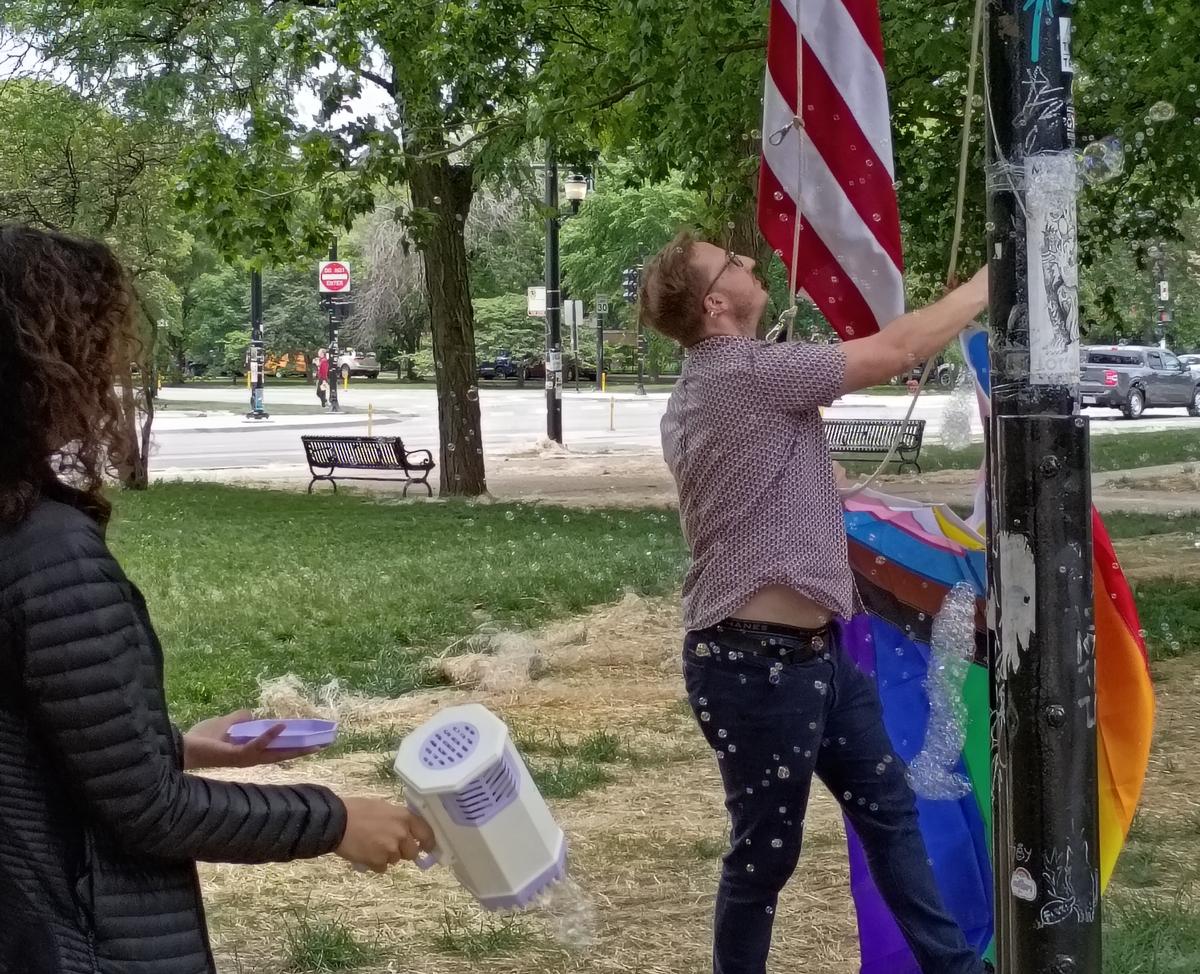
logan square lgbtq pride flag raising.
photo credit // michael oboza
GoPride Gerry is a column of Gerald Farinas
CHICAGO, ILL. -
The rainbow flag is everywhere as Pride month commences. It was ceremoniously raised at Daley Plaza in downtown Chicago, at city and state buildings across Illinois. It was even hoisted at neighborhood gatherings as was done in Logan Square.
You see it on storefronts, bumper stickers, backpacks, laptops and water bottles, and church lawns. My own car has the Philadelphia variant of the flag on my rear window.
When a symbol becomes that common, it is easy to forget that it is not just a seasonal decoration. It is a piece of history, a personal sanctuary, and a statement of survival.
For me, that statement hangs right on my wall. It is the very first Pride flag I ever received as a gift, given to me back in 2004. Since the day I got it, that flag has traveled with me to every single home I have lived in, taking a place of honor on the wall. To anyone else, it might look like a standard piece of colorful fabric, but I prize it because it holds the memory of my own personal coming out story.
As a Filipino American who grew up in a deeply religious family, I was embedded in a culture where homosexuality simply was not talked about or just didn't happen in our household. In an environment like that, the silence is heavy. It tells you, without using words, that who you are is unacceptable, or worse, that you do not exist at all. Breaking through that silence to claim my truth was the hardest thing I have ever done. When I look at that flag on my wall, I do not just see Gilbert Baker’s design. I see my own history of finding the courage to speak up in a world that wanted me to stay quiet. I see the exact moment I chose to live in the light.
To understand why displaying that symbol matters so much on a broader scale, you have to look back at how it started. In 1978, San Francisco activist Harvey Milk approached a young veteran and artist named Gilbert Baker. Milk wanted a unified symbol of hope for the gay liberation movement. At the time, the primary symbol used by the community was the pink triangle. But that triangle carried a heavy, painful weight. It was a badge originally created by the Nazis to identify and persecute gay men in concentration camps. Baker wanted to replace that marker of oppression with something beautiful, something born directly from the community itself.
Working with a team of volunteers in the attic of the Gay Community Center, Baker hand-dyed and stitched the very first flags for the San Francisco Gay Freedom Day Parade. That original design actually had eight colors, and Baker assigned a specific human meaning to each stripe. Hot pink stood for sex, red for life, orange for healing, yellow for sunlight, green for nature, turquoise for art, indigo for harmony, and violet for the human spirit. Over the years, fabric shortages and mass production needs trimmed the design down to the six-striped flag most people recognize today, but the core message never changed. It was created to say: We are here, we are diverse, and we deserve to exist out in the open.
That history matters immensely because of where the country stands today. Under the second Trump administration, the LGBTQ community is facing an intense, coordinated wave of federal rollbacks. Executive orders have stripped away non-discrimination protections, restricted gender-affirming healthcare, and sought to implement a mass discharge of transgender service members from the military. Federal agencies have even been directed to scrub the words "gender" and "gender identity" from official documents, replacing them with restrictive, strictly biological definitions of sex.
This federal hostility has given a green light to culture wars at the local level, where state legislatures are actively trying to ban the flag from public view. Look at Utah, where lawmakers passed a restrictive flag law to prohibit government buildings and public schools from displaying the Pride flag, explicitly aiming to enforce a forced political neutrality that feels a lot like the old silence I grew up with.
But the story does not end with the ban. In a brilliant move of political chess, the Salt Lake City Council stood its ground. Hours before the state law took effect, the city council unanimously voted to adopt new official city standards. They took the Progressive Pride flag, the transgender Pride flag, and the Juneteenth flag, and integrated the city's official emblem, the sego lily, directly onto the designs. By legally adopting them as official city flags, the council completely circumvented the state law. They proved that when top-down power tries to mandate erasure, local communities can find clever, lawful ways to keep their values flying high.
When a government actively works to make a group of people invisible, symbols of visibility become acts of defiance. Flying the Pride flag in 2026 is a way of pushing back against that erasure. It is a visual reminder that no executive order or state law can legislate a community out of existence.
Displaying the flag right now is also an essential signal of safety. For a young queer person living through this political moment, perhaps sitting in a quiet room in a religious home where nobody talks about who they are, the news can feel deeply isolating. Seeing that rainbow outside a home, a business, or a house of worship says: You are seen, you are safe here, and you are not alone.
Pride month has always been rooted in protest, tracing all the way back to the Stonewall riots. The flag was never meant to be a corporate logo or a passive decoration. It was created as a tool for liberation. Flying it today honors the volunteers who mixed those first vats of dye in 1978, celebrates the local leaders fighting back in city halls, and carries our own deeply personal stories of survival forward into the present day.
You see it on storefronts, bumper stickers, backpacks, laptops and water bottles, and church lawns. My own car has the Philadelphia variant of the flag on my rear window.
When a symbol becomes that common, it is easy to forget that it is not just a seasonal decoration. It is a piece of history, a personal sanctuary, and a statement of survival.
For me, that statement hangs right on my wall. It is the very first Pride flag I ever received as a gift, given to me back in 2004. Since the day I got it, that flag has traveled with me to every single home I have lived in, taking a place of honor on the wall. To anyone else, it might look like a standard piece of colorful fabric, but I prize it because it holds the memory of my own personal coming out story.
As a Filipino American who grew up in a deeply religious family, I was embedded in a culture where homosexuality simply was not talked about or just didn't happen in our household. In an environment like that, the silence is heavy. It tells you, without using words, that who you are is unacceptable, or worse, that you do not exist at all. Breaking through that silence to claim my truth was the hardest thing I have ever done. When I look at that flag on my wall, I do not just see Gilbert Baker’s design. I see my own history of finding the courage to speak up in a world that wanted me to stay quiet. I see the exact moment I chose to live in the light.
To understand why displaying that symbol matters so much on a broader scale, you have to look back at how it started. In 1978, San Francisco activist Harvey Milk approached a young veteran and artist named Gilbert Baker. Milk wanted a unified symbol of hope for the gay liberation movement. At the time, the primary symbol used by the community was the pink triangle. But that triangle carried a heavy, painful weight. It was a badge originally created by the Nazis to identify and persecute gay men in concentration camps. Baker wanted to replace that marker of oppression with something beautiful, something born directly from the community itself.
Working with a team of volunteers in the attic of the Gay Community Center, Baker hand-dyed and stitched the very first flags for the San Francisco Gay Freedom Day Parade. That original design actually had eight colors, and Baker assigned a specific human meaning to each stripe. Hot pink stood for sex, red for life, orange for healing, yellow for sunlight, green for nature, turquoise for art, indigo for harmony, and violet for the human spirit. Over the years, fabric shortages and mass production needs trimmed the design down to the six-striped flag most people recognize today, but the core message never changed. It was created to say: We are here, we are diverse, and we deserve to exist out in the open.
That history matters immensely because of where the country stands today. Under the second Trump administration, the LGBTQ community is facing an intense, coordinated wave of federal rollbacks. Executive orders have stripped away non-discrimination protections, restricted gender-affirming healthcare, and sought to implement a mass discharge of transgender service members from the military. Federal agencies have even been directed to scrub the words "gender" and "gender identity" from official documents, replacing them with restrictive, strictly biological definitions of sex.
This federal hostility has given a green light to culture wars at the local level, where state legislatures are actively trying to ban the flag from public view. Look at Utah, where lawmakers passed a restrictive flag law to prohibit government buildings and public schools from displaying the Pride flag, explicitly aiming to enforce a forced political neutrality that feels a lot like the old silence I grew up with.
But the story does not end with the ban. In a brilliant move of political chess, the Salt Lake City Council stood its ground. Hours before the state law took effect, the city council unanimously voted to adopt new official city standards. They took the Progressive Pride flag, the transgender Pride flag, and the Juneteenth flag, and integrated the city's official emblem, the sego lily, directly onto the designs. By legally adopting them as official city flags, the council completely circumvented the state law. They proved that when top-down power tries to mandate erasure, local communities can find clever, lawful ways to keep their values flying high.
When a government actively works to make a group of people invisible, symbols of visibility become acts of defiance. Flying the Pride flag in 2026 is a way of pushing back against that erasure. It is a visual reminder that no executive order or state law can legislate a community out of existence.
Displaying the flag right now is also an essential signal of safety. For a young queer person living through this political moment, perhaps sitting in a quiet room in a religious home where nobody talks about who they are, the news can feel deeply isolating. Seeing that rainbow outside a home, a business, or a house of worship says: You are seen, you are safe here, and you are not alone.
Pride month has always been rooted in protest, tracing all the way back to the Stonewall riots. The flag was never meant to be a corporate logo or a passive decoration. It was created as a tool for liberation. Flying it today honors the volunteers who mixed those first vats of dye in 1978, celebrates the local leaders fighting back in city halls, and carries our own deeply personal stories of survival forward into the present day.